

Table of Contents
- 1. Key Takeaways
- 2. What Are the Main Computer Science and IT Courses in Pune?
- 3. How to Choose the Best Computer Science Course After 12th?
- 4. BCA vs B.Sc Computer Science: Which Course Is Better?
- 5. B.Sc IT vs B.Sc Computer Science: What Is the Difference?
- 6. What Should You Know About BCA Colleges in Pune?
- 7. What Should You Look for in B.Sc Computer Science Colleges in Pune?
- 8. What Should You Consider When Comparing B.Sc IT Colleges in Pune?
- 9. Can You Pursue BCA Without Maths?
- 10. What Are the Career Options After Computer Science and IT Courses?
- 11. What Can You Study After B.Sc Computer Science or B.Sc IT?
- 12. How Important Are Internships, Projects, Skills, and Placements?
- 13. How to Choose the Right Computer Science or IT College in Pune?
- 14. Why Consider MIT ACSC for Computer Science and IT Education?
- 15. Conclusion
- 16. FAQs
Key Takeaways
- There is no single best course; BCA, B.Sc Computer Science, and B.Sc IT suit different interests and career goals.
- BCA focuses on practical applications and software development.
- B.Sc Computer Science builds stronger foundations in programming, algorithms, and computing.
- B.Sc IT focuses on systems, networking, databases, and IT applications.
- M.Sc Computer Science offers advanced specialisation after graduation.
- Choose colleges based on curriculum, faculty, infrastructure, practical exposure, internships, fees, and placements.
- Projects, programming skills, internships, certifications, and industry exposure are crucial for building a successful technology career.
Computer science and IT are continuously evolving fields, as are the degrees that support one's entry into the career. That is precisely why students after Class 12 have so many options, with no single right path to a career in technology.
We are often asked by students and parents about the same: BCA, B.Sc Computer Science, and B.Sc IT are undergraduate-level courses, whereas M.Sc Computer Science is postgraduate-level, available for students with a relevant bachelor's degree. With a wide range of technology and education options in Pune, graduates of these four courses can find work locally. This article covers eligibility, syllabus, skill development, career options, higher education, practical exposure, and placements for the students to compare and decide which course to pursue.
What Are the Main Computer Science and IT Courses in Pune?

BCA concentrates primarily on computer applications: programming, software, databases, and IT applications are considered and approached from a practical, business-oriented perspective.
B.Sc Computer Science offers more in-depth learning of the core components of computing: algorithms, programming, software, and computer systems.
B.Sc IT focuses on IT in a wider sense: networking, databases, web, and systems. M.Sc Computer Science is for postgraduate studies in computer science with specialisation in a particular direction. Each of these courses has an academic focus, and the four are overlapping in some areas, particularly at the elective level.
How to Choose the Best Computer Science Course After 12th?

It is necessary to assess one's interests: the stream in Class 12, comfort with programming and logic, and the desired specialisation area. Furthermore, courses' duration, the amount of practical exposure, opportunities for internships, placements, and college infrastructure and faculty should be considered.
Use this simple decision-making framework:
- Interest in computer applications and IT → BCA
- Interest in computing, programming, and computer science fundamentals → B.Sc Computer Science
- Interest in IT systems, networking, databases, and technology applications → B.Sc IT
- Desire to pursue advanced computer science specialisation after graduation → M.Sc Computer Science
It is important to note that none of the choices are permanent, and students often switch specialisations at the postgraduate level.
BCA vs B.Sc Computer Science: Which Course Is Better?
Both courses offer ways to build a successful and rewarding career in technology, but with a different start. BCA is more applied and business-oriented throughout the course, while B.Sc Computer Science provides a solid foundation for further studies. The primary focus for the two courses is similar, but B.Sc Computer Science offers a more profound understanding of the fundamentals in algorithms.
| Aspect | BCA | B.Sc Computer Science |
|---|---|---|
| Primary Focus | Computer applications and software | Computing concepts and computer science theory |
| Programming | Applied programming for business use | Programming, algorithms, and computational concepts |
| Databases | Database management and applications | Database systems with theoretical grounding |
| Practical Learning | Strong applied and project focus | Balanced theory and practical work |
| Career Options | Software/web development, IT support, testing | Software development, programming, data, technical roles |
| Higher Education | MCA, M.Sc IT, MBA | M.Sc Computer Science, MCA |
Neither of the courses is superior to the other; it is a matter of personal preference and career goals. Someone aiming to build and deliver applications faster often prefers BCA, whereas someone wanting a broader understanding of computer science often prefers B.Sc Computer Science.
B.Sc IT vs B.Sc Computer Science: What Is the Difference?
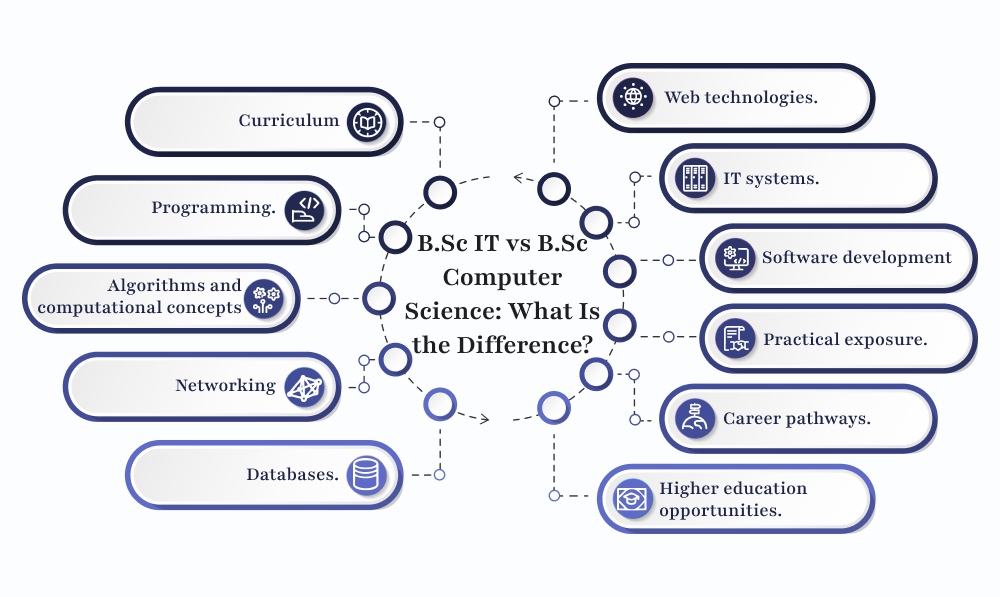
This section is similar to the previous one, with an emphasis on IT-related specialisations. The two courses are comparable but have different focuses.
| Factor | B.Sc IT | B.Sc Computer Science |
|---|---|---|
| Primary Focus | IT systems and technology applications | Computing concepts and computer science |
| Programming | Applied programming and software tools | Programming, algorithms, computational concepts |
| Technology Areas | Networking, databases, web technologies | Algorithms, software development, operating systems |
| Learning Approach | Application and IT-oriented | Programming and computationally oriented |
| Career Direction | IT support, systems, networking, web roles | Software development, programming, data roles |
| Further Studies | M.Sc IT, MCA, MBA | M.Sc Computer Science, MCA |
Those interested in applied IT, systems, networking, databases, and technology implementation often prefer B.Sc IT, whereas those interested in programming, algorithms, and technical problem-solving prefer B.Sc Computer Science. To learn more about career options in B.Sc IT, please refer to this guide.
What Should You Know About BCA Colleges in Pune?
When considering BCA eligibility, syllabus, faculty, computer laboratories, practical learning, programming and project exposure, internships, industry interactions, placement assistance, career guidance, and campus environment should be evaluated.
Other than rankings and popularity, a lot of factors need to be taken into account while choosing between BCA colleges in Pune. Our BCA programme in Pune is focused on industry-oriented computer applications education with internships and placements support.
What Should You Look for in B.Sc Computer Science Colleges in Pune?
Other than eligibility, course syllabus and electives, faculty, computer labs, practical projects, industry exposure, internships, placement assistance, and opportunities for certifications and workshops should be evaluated. Sometimes, the learning environment plays an equally important role as two colleges offering similar syllabi can graduate totally different students.
What Should You Consider When Comparing B.Sc IT Colleges in Pune?
Course syllabus and specialisations, IT infrastructure and labs, programming and database learning, networking and web technology exposure, faculty experience, industry interactions, internships, placement assistance, and fees should be evaluated. When comparing B.Sc IT colleges in Pune with fees, one should consider the complete fee structure, including labs and exams. The two colleges offering similar tuition fees may have significant differences in other areas.
Can You Pursue BCA Without Maths?
This is one of the most frequently asked questions, and the answer is not absolute: eligibility criteria differ from college to college, so it is better to contact the desired institution and learn about its requirements. Another fact is that the absence of Mathematics in Class 12 will not eliminate the possibility of enrolling in every BCA programme, but it is vital to learn about the latest admission criteria for every college. In addition, logical thinking and programming skills can be learned with time. To learn more about the topic, please refer to this article about BCA without Maths.
What Are the Career Options After Computer Science and IT Courses?
The career options for the four courses overlap significantly, but each has its advantages.
| Course | Potential Career Areas |
|---|---|
| BCA | Software Development, Web Development, IT Support, Testing, Databases |
| B.Sc Computer Science | Software Development, Programming, Data, Testing, Technical Roles |
| B.Sc IT | IT Support, Networking, Systems, Web, Databases |
| M.Sc Computer Science | Advanced Software, Data, Systems, Technical Consulting, Research-Oriented Roles |
Graduates of these courses are in demand in a variety of areas: data and analytics, cybersecurity, cloud infrastructure, and technical consulting roles. Digital transformation is taking off in almost all industries: banking, healthcare, retail, manufacturing, and others.
The Indian technology sector is expected to grow to $283 billion in revenue, a 5.1% increase year over year driven by AI adoption.
What Can You Study After B.Sc Computer Science or B.Sc IT?
At the postgraduate level, one can pursue M.Sc Computer Science, M.Sc Computer Applications, M.Sc Data Science, M.Sc Cyber Security, relevant technical certifications, and management programmes (such as an MBA) for students with a technology and business-oriented view.
The specialisation of the postgraduate course should be selected depending on the desired career path. In case of interest in cybersecurity, one should refer to this guide about B.Sc Cyber Security in India.
How Important Are Internships, Projects, Skills, and Placements?
A degree is just the beginning of the long way to a career in technology. Programming skills, communication, analytical thinking, portfolio of projects, internships, industry interactions, certifications, and interview preparation play an equally essential role.
We see this trend reflected in our placements: students who have successfully completed internships and possess a portfolio of projects have a significantly higher chance of interview success. We have prepared this data science placements and internships guide to help our students succeed.
How to Choose the Right Computer Science or IT College in Pune?
A checklist should contain an evaluation of the criteria related to your desired course: eligibility, syllabus, faculty, infrastructure, computer labs, practical projects, industry exposure, internships, placement assistance, fees, scholarship options, location, campus atmosphere, and educational assistance program.
Then, the aspects need to be analyzed to make an informed decision about what course to take; settling for one criterion (e.g., low tuition fees) is a wrong strategy.
The selection of the courses, universities, and career options must be supported by similar analysis of the listed criteria.
Why Consider MIT ACSC for Computer Science and IT Education?
We offer a range of programmes in computer applications, computer science, IT, data science, and postgraduate specialisations with an emphasis on industry-oriented curriculum and practical learning.
Our students benefit from a structured approach to projects, internships, and industry interactions as well as placement and career guidance. For students considering further studies, our M.Sc Computer Science programme is the natural continuation of their studies. We encourage you to compare our curriculum, eligibility, facilities, and career support with your shortlist.
Conclusion
Pune's aspiring computer science and IT professionals have plenty of options when it comes to qualifications and credentials, but a single cookie-cutter approach doesn't do the trick. If you wish to pursue applied, rather than theoretical studies, a degree in BCA might be of interest to you.
For those keen on doing B.Sc Computer Science, the emphasis will be laid on preparing for further studies in the field. B.Sc IT gives insight into systems and networking, while those who are ready to specialize probably need to go for M.Sc in Computer Science.
It is important to choose a course that goes well with your career aspirations and select a college based on the syllabus, faculty, practical work, internships, infrastructure, fees, and overall placement record. If you would like to know more about BCA and B.Sc and M.Sc programs, admission procedure and placements, we would be happy to assist you.
FAQs
Which computer science course is best after 12th in Pune?
None of the courses is best, as they are suited for different goals and interests.
Which is better, BCA or B.Sc Computer Science?
Neither of the courses is better; they have different focuses.
What is the difference between B.Sc IT and B.Sc Computer Science?
The primary focus of B.Sc IT is IT systems and networking, whereas the primary focus of B.Sc Computer Science is programming and algorithms.
Which are the best BCA colleges in Pune?
The best colleges offer in-depth course material, practical infrastructure and support, and a strong record of placements.
How do I choose the best B.Sc Computer Science college in Pune?
Eligibility, syllabus and electives, faculty, lab infrastructure, internship support, and placement assistance should be evaluated.
What should I check when comparing B.Sc IT colleges in Pune with fees?
Placement support and industry exposure should be reviewed in combination with the fee structure.
Can I pursue BCA without Mathematics in Class 12?
It depends on the institution, but some colleges accept applications from students without Mathematics. It is important to learn about the eligibility criteria before applying.
What are the career options after BCA, B.Sc Computer Science, and B.Sc IT?
Software development, web development, IT support, testing, databases, data and analytics, and technical consulting, as well as similar areas.