


Introduction
The digital world has quietly become the backbone of our lives. We use mobile apps to pay bills, attend classes, store documents, talk to family, and run businesses. Almost everything we do today depends on technology working safely and smoothly. But behind this comfort, there is a serious challenge. Data is being created every second, and not all of it is safe.
Every time data moves online, it faces risk. Cyber attacks, data leaks, and system failures are no longer rare news. At the same time, companies are moving their work to online platforms and cloud systems to save costs and grow faster. This shift has made Cyber Security and Cloud Computing two of the most important career paths in the modern IT careers landscape.
India is seeing this change very clearly. According to the IBM Cost of a Data Breach Report 2024, the average cost of a cyber attack in India is now more than ₹19 crore. Another NASSCOM 2024 report shows that cloud adoption in India is growing at over 25% every year. These numbers explain why organisations are investing heavily in security and cloud professionals.
This guide is written to give clarity. It is for students, parents, IT aspirants, and career planners who want to understand skills, scope, courses, and future opportunities in a simple way.
1. Understanding the Scope of Cyber Security Careers in India
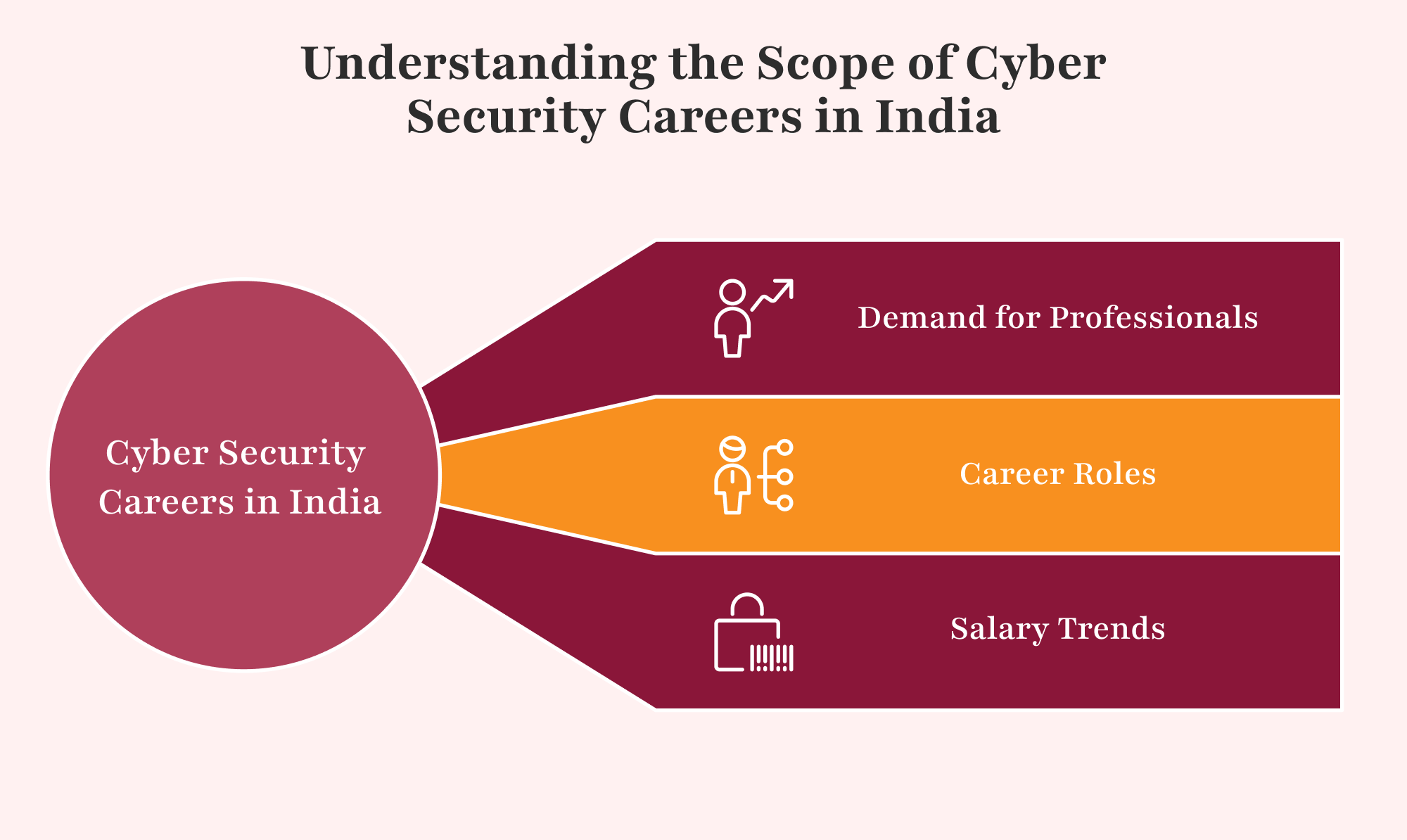
When people talk about the cyber security jobs scope in India, they sometimes think it’s just about sitting in a dark room wearing a hoodie, fighting off hackers like in the movies. But in reality, it’s a massive, professional industry that is the backbone of our economy.
Why India is the New "Hot Spot"
India has gone through a digital revolution. From small street vendors using UPI to massive IT hubs in Bangalore and Pune, we are online more than almost any other country. Plus, a 2025 study showed that while our digital usage went up, our security measures didn't keep pace. This has created a "Security Debt."
And companies are now scrambling to pay off that debt by hiring experts. There is a massive gap between the number of IT jobs market and the number of people who actually know how to do them.
Roles You Can Actually Get:
The salary trends are also looking great. Because the demand is so high and the supply of workers is low, entry-level salaries in India for specialized roles are often 20-30% higher than general coding jobs.
Read More: What Is the Scope of Cyber Security Jobs in India?2. Why Studying Cyber Security Is a Smart Career Move
If you’re asking yourself, "Is cyber security a good career?" you have to look at the long game. Some jobs get automated" away by AI. But Cyber Security is a cat-and-mouse game between humans. As long as there are humans trying to steal data, we need humans to stop them.
A "Future-Proof" Choice
In 2026, the global cost of cybercrime is hitting record highs. According to recent research from Cybersecurity Ventures, cybercrime costs are expected to reach trillions of dollars annually. That is a scary number, but for a student, it's a benefit of studying cyber security as it gives job security.
One of the best Benefits of cyber security courses is that they teach you how to think. You don't just learn a tool; you learn a "defender's mindset." This makes you valuable in any part of an IT company. Whether you're working in finance, healthcare, or government, your skills will always be the most important thing in the room.
Read More: 6 Compelling Reasons Why You Should Study Cyber Security3. Cyber Security for Digital Safety and Awareness
Let’s step away from the job part for a minute. Why does Digital safety matter to you as a person?
We live in an age of super-realistic phishing scams. You’ve probably seen those weird texts saying you won a prize or your bank account is locked. Ten years ago, they were easy to spot because the English was bad. Today, they look perfect because of AI.
Learning about security and knowing why cyber security is important for individuals. Well, isn't just for your resume; it's for your life. When you understand how online security works, you learn:
This awareness is the first step toward cyber threat prevention. You can't protect a big company if you don't know how to protect your own Instagram account!
Read More: Top 10 Reasons to Learn Cybersecurity for Your Digital Safety4. Cyber Security vs Computer Science: Which Path Is Better?
This is where a lot of students get stuck. "Should I just do a general degree, or should I specialize?"
The Difference in a Nutshell
Think of Computer Science as the foundation. It’s like learning how to build a car engine. You learn the math, the logic, and the programming languages. It’s great if you want to be a software developer.
Cyber Security, on the other hand, is a specialization. It’s like being the person who designs the armored plating and the GPS tracking for that car. You still need to know how the car works, but your focus is on risk. Its better to understand what you enjoy more than comparing which IT course is better.
In the debate of Cyber security vs computer science, there is no wrong answer. But in 2026, the "Specialist" is often the one who gets the better job offers. Companies want people who can do the niche stuff that generalists can't.
Read More: What is a BSc in Cybersecurity, and why is it in High Demand?5. Are Cyber Security Courses Necessary for Career Growth?
This is a very common question among students like do cyber security courses help in jobs? Or "can't I just learn this for free on YouTube?"
Well, you can learn the basics for free. But there is a huge difference between watching a video and having a mentor guide you through a real-world scenario. This is why Cyber Security Courses are so important for IT skill development.
Why "Self-Taught" Isn't Always Enough:
1. Trust: A cyber security certification from a respected place like MIT ACSC tells an employer you’ve been tested and you didn't just "guess" the answers.
2. The Lab Factor: In a real course, you get access to "virtual labs." These are safe environments where you can actually practice hacking and defending without getting arrested or breaking your own computer. Basically, you get professional training.
3.The Network: You get to meet people in the industry. Most of the best Cyber security jobs are found through people you know.
Read More: Is It Necessary to Take Cybersecurity Courses?6. Benefits of Cyber Security Courses for Students

If you're still in college or just finishing up, you are at the perfect age to start. Your brain is already in learning mode, and to know the advantages of cyber security courses.
The career benefits of cyber security courses for students are massive. First off, you get hands-on experience. Instead of just reading about a "SQL Injection" (a way hackers steal database info), you actually see it happen and learn how to block it.
What You Really Gain:
7. How Cyber Security Courses in Pune Are Adapting to New Threats
Pune is one of India's biggest IT hubs. If you’re looking for Cyber security courses in Pune, you’re in a great spot because the city is home to some of the biggest tech companies in the world.
But here’s the thing: The threats are changing every day. A course that was written in 2022 is already out of date. The hackers have moved on.
What Modern Training Looks Like:
The best schools are now focusing on things like Cloud Security and AI-driven attacks. They are teaching students how to use Machine Learning to spot a hacker before they even get inside the network. If you’re going to study in Pune, you need to make sure your school is keeping up with the best cyber security courses in Pune, an industry-aligned curriculum, and modern cyber security training.
At MIT ACSC, the curriculum isn't just about old textbooks. It’s about what’s happening right now in the industry. We make sure students are ready for the 2026 job market.
Read More: How Cyber Security Courses in Pune Are Adapting to New Threats8. Why Cloud Computing Skills Are Essential for BCA Graduates

If you are a BCA (Bachelor of Computer Applications) student, listen up! The world has moved "off-site." In the old days, a company would have a "Server Room" with big, loud machines. Today, that room is gone. It’s all in the Cloud.
Why BCA Students Need the Cloud:
If you graduate with a BCA but don't have Cloud computing skills for BCA students, you’re going to struggle. Why? Because almost every modern app is built on a cloud platform like AWS (Amazon Web Services), Azure (Microsoft), or Google Cloud.
Here are some of the highest-paying Cloud computing careers for BCA students:
DevOps Engineer: You help developers and IT teams work together using cloud tools to launch apps faster.
A recent 2025 survey showed that 90% of enterprises now use some form of cloud technology.
Read More: A Complete Guide to Choosing and Excelling in a BCA ProgramConclusion
We’ve covered a lot of ground today! Cyber security and Cloud Computing have clearly emerged as high-growth, future-ready career paths in today’s digital economy. As organisations depend more on online systems, cloud platforms, and data-driven operations, the demand for skilled professionals in these fields continues to rise across industries. Choosing the right courses, building practical skills, and selecting the correct specialisation play a crucial role in shaping a strong and sustainable career in IT.
With focused learning, hands-on exposure, and continuous upskilling, students can prepare themselves for real-world challenges and long-term growth. Institutes like MIT ACSC support students through industry-relevant cyber security courses in Pune, and career-oriented guidance, helping them develop job-ready skills and move confidently towards successful futures in Cyber Security and Cloud Computing.