

Table of Contents
1. What Is B.Sc Cyber Security and How the Course Is Structured?
2. Why B.Sc Cyber Security Is a Popular Career Choice After 12th
3. Key Benefits of Studying B.Sc Cyber Security
4. The Learning Experience in Cyber Security Colleges
5. Importance of Cyber Labs and Hands-On Security Training
6. Campus Life and Student Experience in Cyber Security Programs
7. Career Opportunities After Completing B.Sc Cyber Security
8. Cyber Security Salary Trends and Future Scope in India
9. Skills Required to Succeed in Cyber Security
10. B.Sc Cyber Security vs Other Computer Science Courses
11. Challenges Faced by Cyber Security Students and How to Overcome Them
12. How to Choose the Right Cyber Security College in India
13. Conclusion
1. What Is B.Sc Cyber Security and How the Course Is Structured
With organisations facing constant threats from data leaks and major system breaches, securing digital networks has become a top priority. As businesses, financial institutions, and government bodies invest heavily in protecting their digital infrastructure, the demand for trained professionals has grown. This growing challenge has made a BSc Cyber Security a popular route for students keen on network defence.
For students completing their higher secondary school education, understanding what is BSc cyber security and evaluating its career prospects is essential. This cyber security degree in India is structured to help students acquire both practical skills and theoretical methodologies. This guide provides an overview of the academic curriculum, career opportunities, industry demand, and salary expectations for those considering a professional career in this sector. So, scroll down!
The BSc in Cyber Security is typically a three-year undergraduate degree divided into six semesters. Designed for candidates who have completed their higher secondary education, preferably with a background in science and mathematics, the cyber security curriculum is constructed to bridge academic theory and industry applications.
During the initial semesters, students focus on core computer science fundamentals, including operating systems, programming languages, and basic computer networks. As the programme progresses, the cyber security syllabus introduces more specialised subjects. Students explore key subjects in cyber security course programmes, such as network security, digital forensics, applied cryptography, and security architecture.
A significant portion of a modern cyber security degree involves understanding how to secure software systems and detect structural vulnerabilities. For those wanting a deeper understanding of this qualification, reading about What Is a BSc in Cyber Security and Why Is It in High Demand?
2. Why B.Sc Cyber Security Is a Popular Career Choice After 12th
Choosing a path after the 12th standard requires looking closely at long-term job stability and sector growth. This field has become a popular choice due to several factors -
- Rapid digital transition - The expansion of internet access and cloud adoption in India has created new security vulnerabilities. This has led organisations in banking, healthcare, and e-commerce to actively search for specialists to protect consumer data.
- High career resilience - When deciding if is cyber security a good career option, students often note that digital security is a continuous operational necessity rather than a seasonal requirement. This provides consistent career stability even during economic shifts.
- Expanding regulatory demands - The scope of cyber security in India continues to grow as new national data protection laws require companies to build and maintain dedicated security teams.
- Directly applicable skills - Starting a cyber security education early allows students to build practical, targeted skills that align with current employer requirements.
To understand these career drivers in more detail, you can read 6 Compelling Reasons Why You Should Study Cyber Security.
3. Key Benefits of Studying B.Sc Cyber Security
Pursuing an undergraduate information security degree offers several distinct advantages over more generalised computing programmes, including -
- Development of immediate practical skills - Students acquire industry-aligned cybersecurity skills that allow graduates to contribute constructively from their first day in an organisation.
- Mastery of complex technical processes - These programmes prepare students to manage essential defensive tasks, such as threat hunting, identity and access management, and systematic vulnerability assessments.
- Preparation for professional certifications - A structured degree provides a reliable academic foundation for pursuing highly regarded global credentials, such as Certified Ethical Hacker (CEH) or CompTIA Security+.
- Long-term professional readiness - The benefits of cyber security courses extend well beyond initial job placement. By learning to apply industry standards early in their education, students establish a resilient foundation for the future of cyber security careers.
For a detailed breakdown of these academic and professional advantages, please read What Are the Benefits of Cyber Security Courses?.
4. The Learning Experience in Cyber Security Colleges
The academic environment within modern institutions is designed to balance theoretical principles with hands-on application. While learning theoretical concepts, such as security policies and protocols, is necessary, the actual value of a cyber security degree lies in practical exposure.
Students spend a significant amount of time in laboratory environments learning how to identify network anomalies, run basic penetration testing tools, and manage incident responses. The practical training in cyber security includes structured simulations where students learn to identify security weaknesses in simulated networks.
Institutions offering cyber security courses in Pune and other technology hubs are regularly updating their training models to address emerging threats. To see how educational methods are evolving to meet these challenges, read about How Cyber Security Courses in Pune Are Adapting to New Threats.
5. Importance of Cyber Labs and Hands-On Security Training
Because digital defence is an applied discipline, theoretical lectures alone are insufficient to prepare students for real-world threats. This is where the importance of cyber labs becomes evident. These specialised laboratories provide secure, isolated sandbox environments where students can safely execute malware, analyse virus behaviours, and perform simulated cyberattacks.
Through cybersecurity learning in a controlled lab, students learn how to think like system attackers to build better defences. They gain experience using industry-standard tools for network monitoring, packet analysis, and digital forensics. This style of cyber security practical training helps students build analytical problem-solving skills that are difficult to learn from textbooks alone. To understand how these dedicated facilities enhance the quality of education, read more on the Importance of Cyber Labs in Cyber Security Education.
6. Campus Life and Student Experience in Cyber Security Programs

Beyond standard classroom schedules, student life in cyber security colleges is enriched by collaborative activities and practical learning groups. Many institutions foster academic clubs where students work together on complex coding challenges, exchange knowledge on emerging software vulnerabilities, and prepare for external industry events.
These facilities usually provide students with access to modern cyber security campus facilities, including advanced computing labs, high-speed networks, and specialised simulation software. Participating in hackathons, collaborative workshops, and interactive peer projects helps students build a strong community. This shared cyber security college experience is helpful for developing the teamwork and communication skills required to manage real-world security incidents. For insights into campus life and general student opportunities, read about Cyber Security Colleges in India - Courses, Careers and Opportunities.
7. Career Opportunities After Completing B.Sc Cyber Security

Graduates of a BSc in Cyber Security have access to a wide variety of specialised roles across multiple industries. As organisations expand their digital operations, they require dedicated specialists to secure their information assets.
Some of the common cyber security jobs available to graduates include -
- Cyber Security Analyst - Monitoring networks for unusual activities and managing security incidents.
- Ethical Hacker - Identifying vulnerabilities in software systems by performing authorised security tests.
- Penetration Tester - Systematically testing networks and applications to find and document security flaws.
- Digital Forensics Investigator - Analysing digital evidence after security breaches or digital crimes.
- Information Security Analyst - Planning and implementing security measures to protect sensitive data systems.
- Cloud Security Specialist - Designing and maintaining security protocols for cloud-based computing architectures.
These opportunities exist across a variety of sectors, including banking, financial services, healthcare, telecommunications, and government agencies. This broad relevance ensures that the career after BSc cyber security offers various paths for professional growth. To learn more about career paths and recruitment patterns, read Cyber Security Colleges in India - Courses, Careers and Opportunities.
8. Cyber Security Salary Trends and Future Scope in India
The cyber security salary in India is influenced by factors such as technical skills, certifications, geographic location, and the hiring organisation's industry. Entry-level professionals typically start with competitive compensation packages, which can increase as they gain experience and specialised certifications.
As professionals transition into mid-level and senior roles, such as Security Architects or Chief Information Security Officers, their compensation reflects the high level of responsibility involved. The ongoing transition toward automated and intelligent systems means that professionals who understand how to protect AI-driven infrastructures are in demand. To understand how emerging technologies are shaping the future of cyber security careers and market compensation, read Cyber Security Graduates Are in High Demand in the AI Era.
9. Skills Required to Succeed in Cyber Security
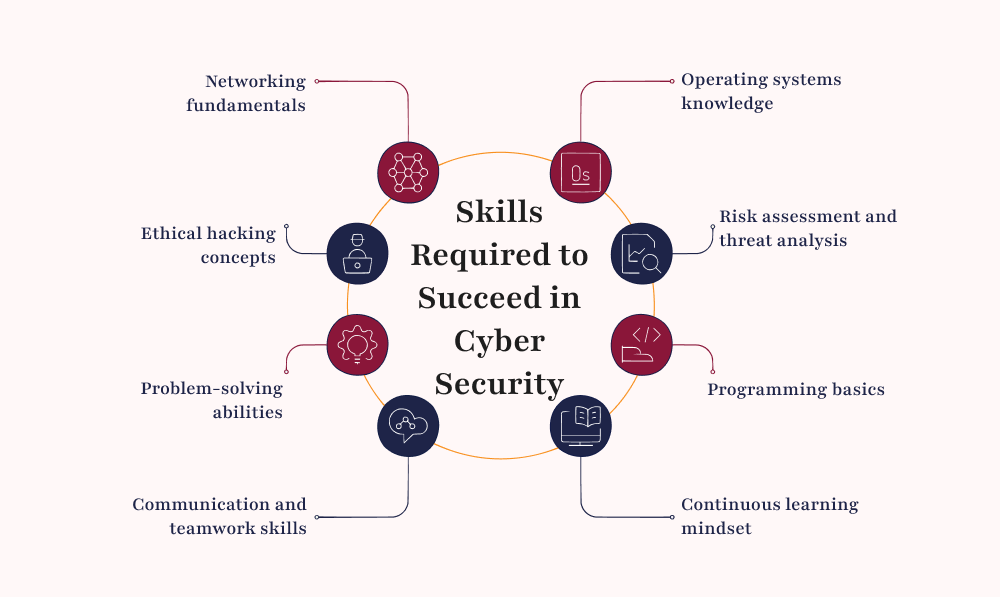
Understanding skills required for cyber security professionals begins with a clear knowledge of operating systems, including Linux and Windows, along with basic computer networking concepts.
Key cybersecurity skills for beginners include -
- Networking Fundamentals - Understanding protocols, routers, switches, and firewalls.
- Basic Programming - Familiarity with languages like Python or Bash for automation.
- Threat Identification - Recognising common attack methods, such as phishing and malware.
- Analytical Thinking - Methodically analysing security logs to identify anomalies.
To determine whether formal training is necessary to acquire these cybersecurity competencies, read Is It Necessary to Take Cybersecurity Courses for a detailed assessment of structured learning environments versus self-directed study.
10. B.Sc Cyber Security vs Other Computer Science Courses
Students considering higher education in computer technology often compare different degree pathways to see which programme aligns best with their professional goals.
| Feature | BSc Cyber Security | BSc Computer Science | BCA (Bachelor of Computer Applications) |
|---|---|---|---|
| Primary Focus | Security, cryptography, and network defence | Software development, algorithms, and theory | Practical business applications and software development |
| Core Subjects | Ethical hacking, forensics, network security | Data structures, database management, mathematics | Web development, database systems, software engineering |
| Career Path | Security Analyst, Penetration Tester | Software Engineer, System Analyst | Application Developer, IT Administrator |
When evaluating whether cyber security or computer science which is better, the decision usually depends on your interest in specialisation. A standard computer science degree offers a broader foundation in general programming, while a specialised cyber security degree focuses directly on defence methodologies. Similarly, comparing cyber security vs BCA highlights the difference between general application development and specialised system defence.
Read more about it here - Cyber Security Colleges in India - Courses, Careers and Opportunities.
11. Challenges Faced by Cyber Security Students and How to Overcome Them
Studying digital security comes with its own set of challenges. One of the main problems faced by cyber security students is the rapid pace of technological change. Security tools, operating system updates, and attack methods evolve quickly, meaning that textbooks can sometimes become dated.
To address these cyber security challenges, students must develop a habit of continuous self-directed learning. This involves reading security bulletins, practising on open-source platforms, and pursuing professional certifications. Understanding how to succeed in cyber security requires combining academic study with hands-on practice in dedicated lab environments.
Read more here: How Cyber Security Courses in Pune Are Adapting to New Threats.
12. How to Choose the Right Cyber Security College in India
Selecting the right academic institution is a key step in building a career in this field. Students should evaluate several parameters when researching cyber security colleges in Pune and other educational hubs in India. Key factors to consider include -
- Curriculum Alignment - Ensure the programme covers modern topics like cloud security and threat hunting.
- Lab Infrastructure - Check if the college has dedicated, modern cyber labs for practical training.
- Faculty Expertise - Look for instructors with industry experience or relevant professional certifications.
- Placement Assistance - Research the college's history of industry connections and career support services.
Evaluating these aspects systematically helps in the cyber security institute selection process. To guide your decision-making, read about How to Choose the Best Cyber Security Institute in Pune to find a programme that aligns with your educational goals.
13. Conclusion
Pursuing a BSc Cyber Security offers students a structured pathway into a vital and evolving technical sector. As organisations continue to digitise their operations, the need for skilled professionals who can protect valuable networks and data remains consistent. By combining theoretical knowledge with practical experience in dedicated lab facilities, students can build the necessary technical foundation to succeed.
For those looking to begin this journey, the MIT ACSC cyber security program provides a structured curriculum and hands-on guidance from experienced faculty. This academic approach, supported by proactive career development initiatives and strong cyber security placement opportunities, helps prepare graduates to navigate the challenges of the modern digital security landscape.