


1. Introduction
The BBA course is one of the strongest undergraduate options for students who want business knowledge, career flexibility, and a clear route into management.
A BBA degree builds your foundation in marketing, finance, HR, analytics, communication, and decision-making.
A Bachelor of Business Administration works well for students who want jobs after graduation, a stronger business profile, or a direct path towards management education.
MIT ACSC offers BBA as a three-year full-time undergraduate programme with specialisations in entrepreneurship, finance, HR, and marketing.
India Skills Report 2025 says overall graduate employability is projected at 54.81%, while management graduates lead with 78% employability.
2. What Is BBA And How Is The Course Structured?
The Bachelor of Business Administration is an undergraduate management degree that introduces students to how organisations function. You study the language of business early, then build practical understanding through projects, presentations, internships, and specialisation papers.
At MIT ACSC, BBA is a three-year format with core areas such as Principles of Management, Business Accounting, Business Communication Skills, Design Thinking and Innovation, Research Methodology, and major papers in HR, Finance, and Marketing. That answers one of the most searched questions around BBA course duration and subjects.
Typical areas in a strong BBA course include:
- Management principles
- Marketing fundamentals
- Finance and accounting basics
- Human resource management
- Organisational behaviour
- Business communication
- Entrepreneurship
- Analytics or research-based learning
Students comparing curriculum depth can read A Complete Guide To Choosing And Excelling In A BBA Program for a more detailed programme-level view.
3. Why Is BBA A Popular Career Choice After 12th?
The BBA degree has gained traction because it gives students from commerce, science, and arts a practical entry into business education. It does not narrow your path too early. It gives structure without shutting down future choices.
In 2025, India Skills Report projected overall graduate employability at 54.81%, with management graduates leading at 78%, while AISHE had already opened data submission for the 2024-25 higher education cycle and listed 2024-25 as the active student enrolment reference year in 2026.
In a market this large, students and parents now compare employability, exposure, and long-term career value far more carefully. That is one reason BBA in India keeps attracting attention.
Students asking whether BBA is the right move after school can explore Is BBA A Good Career Option, which looks closely at outcomes, fit, and career direction.
4. What Are The Key Benefits Of Studying BBA?
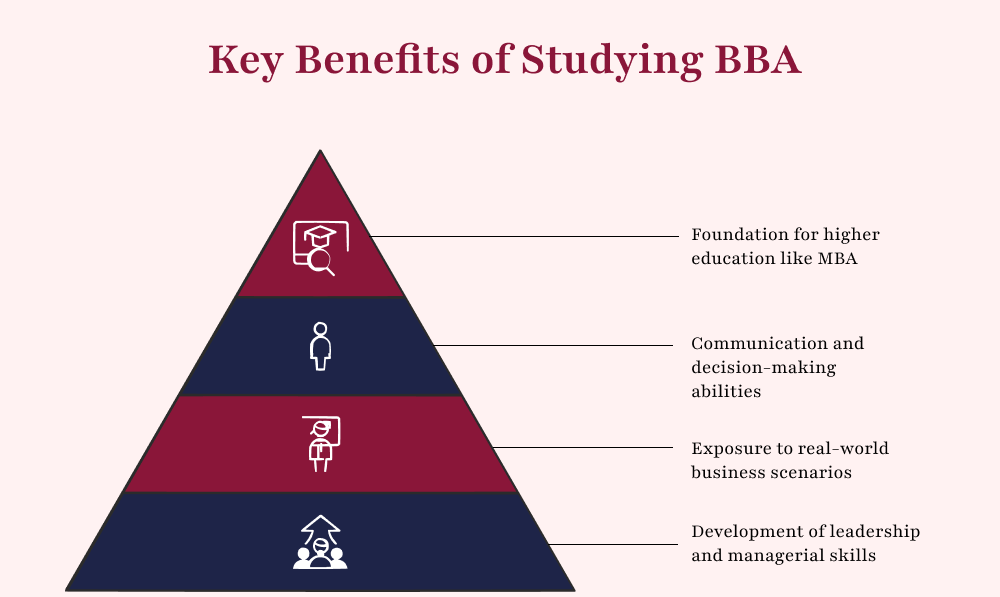
A good BBA course does more than teach business terminology. It trains students to think in commercial terms and act with more structure.
Key strengths of a BBA degree include:
- Stronger communication and presentation ability
- Early exposure to business functions
- Better understanding of management and markets
- Improved leadership and team coordination
- A base for jobs, entrepreneurship, or postgraduate study
MIT ACSC’s brochure says the programme uses lectures, assignments, seminars, guest lectures, and internships, while its training and placement support focuses on communication and employability skills. That practical mix explains the continuing scope of BBA in India.
Students exploring the qualities that separate stronger colleges from average ones can read Key Factors That Define A Top BBA College In 2025.
5. How Do Students Learn In BBA Colleges?
Real business learning happens through application. Theory matters, but students improve faster when colleges combine concepts with business problems, projects, and speaking practice.
MIT ACSC’s programme structure shows papers such as Business Communication Skills, Design Thinking and Innovation, Security Analysis and Portfolio Management, Brand Management, International Human Resource Management, and research-focused work. That blend helps students connect academic learning with workplace use.
In most strong colleges, BBA learning includes:
- Case studies
- Presentations
- Group projects
- Internships
- Guest sessions
- Applied assignments
That is essential because practical learning shapes confidence. Students reviewing campus fit, training, and exposure can continue with How To Choose The Right BBA College In Pune.
6. What Is Campus Life Like In BBA Programmes?

Campus life influences business learning more than many students expect. Clubs, presentations, competitions, peer groups, and events give students repeated chances to speak, coordinate, and lead.
MIT ACSC highlights student development, career guidance, training, and placement support within its broader ecosystem. For BBA students, that type of environment usually improves peer learning and professional confidence.
Students comparing campus environment, student experience, and overall college exposure across institutions can review BBA Colleges In India.
7. What Career Opportunities Open Up After BBA?

This is the question that drives most admissions decisions. The Career after BBA course can move into several business functions depending on your specialisation, skill level, internships, and communication ability.
MIT ACSC shows career directions such as HR Manager, Business Development Executive, Executive Assistant, International Brand Manager, Export Manager, and International Finance Manager. Early job titles will usually be trainee or executive-level, but the role families are clear.
Common opportunities after a BBA degree include:
- Marketing executive
- Sales executive
- HR executive
- Business development executive
- Operations executive
- Management trainee
- Client servicing executive
8. What Does BBA Salary In India Usually Look Like?
Salary depends on role, city, college quality, internships, and how well you perform in interviews. No serious guide should suggest one fixed number.
Glassdoor job listings for BBA fresher roles in India show many openings clustered around roughly ₹2 lakh to ₹6 lakh per year, with city, function, and employer affecting the range. These are market snapshots, not guaranteed salary bands.
The main drivers behind BBA salary in India include:
- Specialisation
- Internship record
- Communication skills
- Job location
- Employer brand
- Digital, finance, or analytics capability
That is why the future growth of a BBA degree depends on how students build skills around the degree, not on the degree title alone.
Before comparing BBA with other undergraduate paths, it helps to see where the advantage sits in practice. The table below gives a quick view.
| Factor | BBA Course | General Graduation Without Business Focus |
|---|---|---|
| Business Exposure | Starts in Year 1 | Often limited |
| Career Direction | Early access to business roles | May need later specialisation |
| Presentation And Communication | Usually built into the course | Depends on stream |
| Internship Relevance | Strong for business functions | Varies widely |
| MBA Readiness | High | May require extra bridge learning |
This comparison explains why students who plan for management, entrepreneurship, or postgraduate business study often prefer the BBA course.
Read more: Top BBA Colleges In India9. Why Is Pursuing An MBA After BBA A Smart Choice?
A BBA degree gives breadth. An MBA sharpens that into higher-level specialisation, leadership range, and stronger long-term career positioning.
India Skills Report 2025 places management graduates at the top of employability metrics among major categories. That supports the logic behind moving from BBA to MBA for students aiming at stronger managerial roles.
Students planning the next step after BBA can explore the MBA program at MIT ACSC and compare the broader context around top MBA colleges in India.
These routes help when you are evaluating skills gained from MBA.
10. What Challenges Do BBA Students Face, And How Can They Overcome Them?
The biggest challenge is not the syllabus. It is passivity. Students who complete the Bachelor of Business Administration without internships, communication improvement, or project work usually struggle more in placements.
Common challenges include:
- Weak interview readiness
- Limited practical exposure
- Confusion about specialisation
- Average communication skills
- Too much theory, too little application
The fix is clear. Build one domain skill, take internships early, improve writing and speaking, and stay active in projects.
Read more: Tips For Cracking BBA Entrance Exams11. Final Thoughts
The BBA course is extremely useful for students wanting an early glimpse and exposure to the business world. BBA graduates in India can venture into jobs, start businesses, or pursue further studies, and the employment opportunities and flexibility available to BBA graduates is immense.
The future growth of a BBA degree improves sharply when students choose the right college, build practical skills, and plan the next step with care.
At MIT ACSC, we assist students by providing guidance through our developed business curriculum, embedded learning opportunities, and training and placement assistance. Students are expected to study the curriculum and different specializations offered and apply before the admission cycle closes.
Have a passion for business and are ready to take the next step in your career? If you are looking for a college that integrates academic rigor, practical learning, and career guidance, you have come to the right place. Be sure to apply as soon as possible.
12. FAQs
Is BBA A Good Career Option After 12th?
Yes. It gives early business exposure, flexible career options, and a clear route to jobs, entrepreneurship, or MBA after graduation.
What Is The BBA Course Duration And Subjects?
Usually three years. Subjects include management, accounting, business communication, marketing, HR, entrepreneurship, and specialisation papers in finance, marketing, or HR.
What Is The Career Scope After A BBA Degree?
Graduates enter marketing, HR, sales, operations, client servicing, management trainee roles, or continue with MBA for stronger long-term growth.